When Business Tools Leave the Shop: What Insurance Covers?
Portable tools can face different coverage rules at the shop, in a van, and on a job site. Learn what to check before a loss.
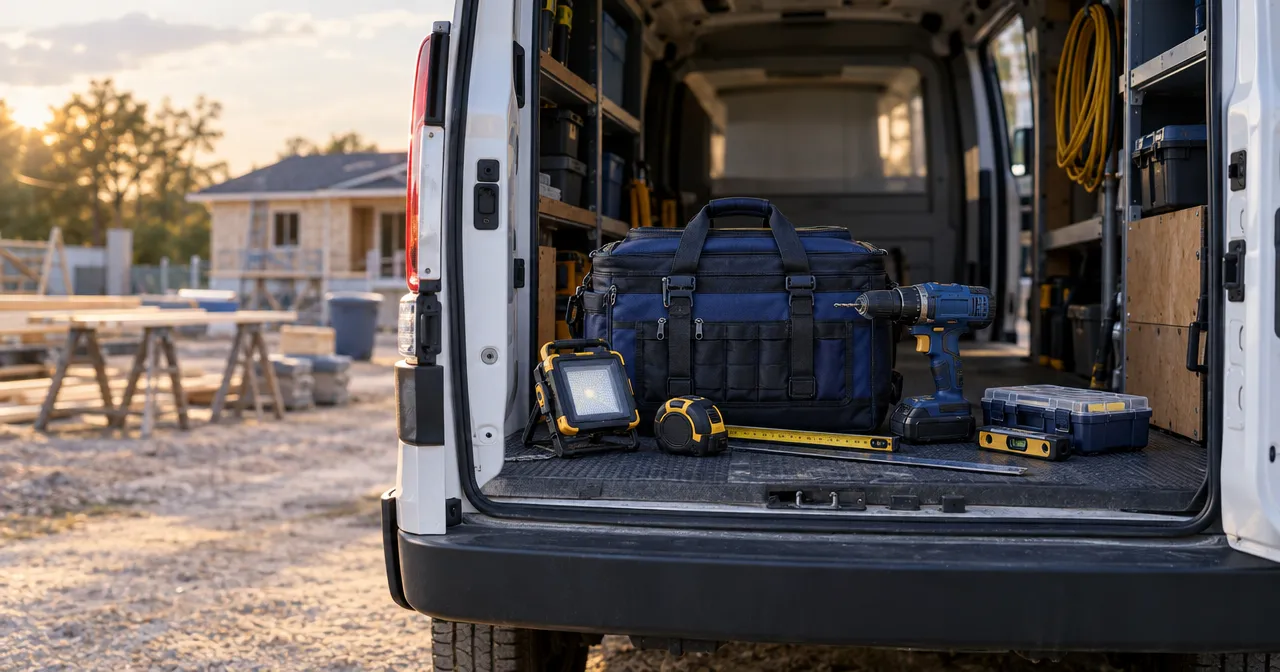
A contractor locks up a van after the last appointment. A photographer takes camera cases from the studio to a client site. A repair business borrows a specialized machine for one project. Each business has equipment it relies on, but the familiar phrase “our property is insured” does not answer whether that property is insured where it actually is.
Portable equipment can move from a listed premises to a vehicle, a temporary job site, an employee’s home, or a third-party storage space in a single week. Those changes raise questions about covered locations, property ownership, theft conditions, valuation, and deductibles. This guide offers a practical way to check the policies you have—not a promise that every off-site loss is covered.
Begin with the property, not the policy name
Make a short list of what leaves your regular location. Group it by what it does and who owns it: handheld tools; larger machines; laptops, cameras, or testing devices; inventory or materials awaiting installation; and equipment rented or borrowed from someone else. Note the typical highest value away at one time, not just the average day’s load.
A landscaping business, for example, might own two mowers and several handheld tools while occasionally renting a compact machine. The business may have a property policy, a commercial auto policy for its truck, and liability coverage. Those names alone do not establish which contract protects each mower or rental. The declarations, coverage forms, schedules, endorsements, and rental agreement have to be read together.
The NAIC’s small-business insurance guide separates business property, general liability, business interruption, and commercial auto, and advises owners to keep detailed records of equipment and policy documents. That separation is useful here: damage to your own tools is a property question; an injury or damage to someone else’s property may be a liability question; a damaged vehicle is an auto question. One incident can create more than one question.
What does your business property or BOP cover away from the premises?
A business owners policy (BOP) can combine business property and liability with business-income protection, but it does not automatically solve every off-premises exposure. Commercial property policies usually begin with a described location and covered property. Some forms include limited protection for property temporarily elsewhere or in transit; the amount, distance, cause of loss, and conditions vary. The Insurance Information Institute’s explanation of inland marine coverage notes that some BOP or commercial-package property protection can extend to traveling tools, while movable or high-value property may call for separate coverage.
Ask for the actual off-premises provision and the definitions it uses. Is a client’s building a covered location? What about equipment left overnight in a locked job trailer, stored with a third party, or taken home by an employee? Does a small off-premises sublimit apply even when the main business-personal-property limit looks generous? A $50,000 property limit at the shop, for instance, does not necessarily mean $50,000 follows a crew to every work site. That number is only an illustration, not a policy term offered by 5280.
Also distinguish property from materials that will become part of someone else’s project. A box of ordinary supplies, a cabinet waiting to be installed, and a customer’s item left with you may be defined differently. Tell the licensed team member what the business transports and whose property it is, rather than assuming “tools” covers the whole load.
The vehicle and its contents are different insurance questions
Commercial auto coverage addresses the insured vehicle and, when purchased and applicable, auto liability or physical damage. Comprehensive coverage may address theft damage to a covered van. That does not mean loose drills, instruments, or inventory inside the van are automatically paid for under the vehicle’s physical-damage coverage. Progressive Commercial’s discussion of van insurance explicitly distinguishes loose tools and materials from the van itself. Policy forms vary, so check your own contracts rather than treating that carrier’s explanation as universal.
Consider a van break-in that damages a door and removes $7,000 of portable tools. The door could raise a commercial-auto physical-damage question. The tools raise a business-property or portable-equipment question. If a permanently attached rack or built-in equipment is damaged, ask whether it is treated as part of the insured vehicle or must be listed separately. Photograph the vehicle, list the missing items, and notify the appropriate insurers promptly; do not assume a single claim submission reaches every policy.
If an employee uses a personal vehicle to carry company property, there are two additional questions: whether the vehicle’s business use is properly disclosed and insured, and whether business property remains covered while in that car. The answer to one does not establish the other. For more on the vehicle side, see 5280’s commercial auto guide.
When a portable-equipment form may fit better
“Inland marine” sounds like boat insurance, but in this context it refers to movable property such as tools and equipment while in transit or at temporary locations. A contractors’ equipment form or tool-and-equipment floater is one possible way to address those exposures. It is not a single standardized promise: insurers define covered property, locations, causes of loss, exclusions, and values in their own forms.
Travelers’ contractors’ equipment overview identifies theft, transit, and job-site risks, and discusses owned as well as certain leased or borrowed equipment. It also says the policy specifies risks and types of equipment not covered. Use that as an example of the questions to ask, not as confirmation that a particular Travelers form, endorsement, or other carrier’s product is available to your business.
A small retailer carrying point-of-sale equipment to pop-up events may need a different discussion from a trade contractor moving heavy machinery. A photography studio taking lenses and lighting on location may require careful scheduling of high-value items. A delivery business carrying customers’ goods may need coverage for cargo or property of others rather than assuming its own tool policy covers those goods. Describe the actual operation before choosing a label.
Check the limit that applies to each item and each trip
A declarations page may show a total or “blanket” limit for covered equipment, a per-item limit for unscheduled tools, a schedule for individually listed machines, and separate limits for rented property or property of employees. A theft sublimit or condition may apply as well. The total shown on the first page is not always the number governing a particular loss.
Suppose a business owns $18,000 in portable equipment and often takes $12,000 of it to a job. If an illustrative policy covered up to $10,000 in total away from the shop and capped an unscheduled item at $2,000, a $4,000 specialty instrument could be underinsured even before the deductible. These are hypothetical amounts to show how both a total cap and an item cap matter; they are not quotes, standard limits, or predictions of claim payment.
Ask whether the equipment is scheduled by make, model, and serial number or covered under a blanket amount. Inventory can grow quietly: a second crew, a new camera kit, or a purchased machine may push the total beyond the current limit. Find out what the policy says about newly acquired equipment, reporting requirements, and any temporary allowance. Do not wait until renewal to report a major acquisition if the contract requires earlier notice.
Value and deductible: what could you actually recover?
Replacement cost generally points to the cost of replacing covered property with comparable property, subject to policy conditions. Actual cash value generally accounts for depreciation. An agreed or scheduled value may work differently. None of those terms means a check for the original purchase price, and reimbursement may depend on repairability, documentation, applicable limits, and whether replacement is completed under the policy’s terms.
For a quick comparison, imagine a covered loss to a tool bought for $3,000 several years ago. An actual-cash-value settlement might be less than the current price of a similar new tool. A replacement-cost form might pay in stages or require proof of replacement; its precise wording controls. Ask how batteries, accessories, custom attachments, and sales tax are treated. If specialized equipment is no longer made, ask what comparable replacement means under that form.
The deductible is equally important when a claim involves many small items. A hypothetical $4,000 covered loss with a $1,000 deductible would have $3,000 left before any sublimits, valuation, exclusions, and other adjustments. But a $1,200 loss under that same hypothetical deductible could result in much less practical recovery. If the business prefers a higher deductible to manage premium, it should plan to absorb that portion of a loss. Ask whether separate deductibles apply if both the vehicle and its contents are insured under different policies.
Borrowed, rented, and employee-owned equipment need their own line on the inventory
A rental contract may assign the business responsibility for a machine even though it does not own it. A technician may bring personally owned tools to work. A neighboring contractor may lend a specialized item for a day. None of these belongs automatically in the “owned equipment” total. Record the owner, replacement value, dates, permitted use, and any contractual insurance requirement.
Travelers’ discussion of renting and borrowing contractors’ equipment explains that policies can treat rented, borrowed, and leased items differently from purchased items and that a rental provider’s damage option can have its own restrictions. Before signing, ask what the rental agreement makes your business responsible for, whether your existing policy includes the item, and whether any separate rental protection overlaps or leaves gaps. Avoid assuming that an equipment-owner’s policy will protect your business’s interest or satisfy its contract.
Employee-owned property deserves a separate question. If a worker’s personal drill is stolen with company-owned tools, check whether the business policy includes property of employees and what limit applies. Do not promise reimbursement from the company’s policy or from the worker’s homeowners policy without checking those contracts and the facts.
A stolen tool can interrupt work without triggering business-income coverage
A missing piece of equipment can delay appointments, force a short-notice rental, or leave a crew idle. The cost of replacing the tool and the cost of lost work are different losses. A BOP may include business-income or extra-expense coverage, but the triggering event, covered property, location, waiting period, and period of restoration must be met under the actual form. It is unsafe to assume that any stolen tool automatically produces a business-interruption payment. The NAIC’s business interruption and BOP overview describes those coverages as related but distinct parts of a business package.
Ask a concrete question: if one essential machine is damaged at a temporary job site, is the machine covered, and would rental of a substitute or lost income qualify under any applicable extension? Some policies address rental costs or extra expenses in specific circumstances; others do not. The answer depends on endorsements, conditions, and availability, not on how urgent the project feels. The agency’s commercial insurance guide can help place property, liability, auto, and income protection in one conversation.
A ten-minute review before the next job
Bring a current equipment inventory, a sample rental agreement, and declarations and endorsements for business property, BOP, commercial auto, and any portable-equipment policy. Then ask a licensed team member:
- Which items are insured, who owns them, and which forms address company property, rented property, and employee-owned tools?
- At which premises, vehicles, job sites, temporary storage locations, and employee homes does coverage apply? Are there territory, distance, or overnight restrictions?
- What are the per-item, off-premises, theft, rented-equipment, and total limits? Which items must be scheduled, and when must new equipment be reported?
- What causes of loss are covered or excluded? Does the form impose security, locked-vehicle, storage, or reporting conditions relevant to our actual routine?
- How will a claim be valued, and what deductible applies to tools versus vehicle damage? Does any extra-expense or income provision respond to a qualifying off-site loss?
- If a loss happens, which carrier should be notified, what documentation is needed, and what immediate steps are required to limit further damage?
A dated inventory with photos, serial numbers, receipts, and rental records makes those questions easier to answer and can make a later claim easier to document. Store a copy away from the equipment itself. If a loss has already occurred, contact the insurer or claims number on the policy promptly; a website inquiry is not a claim report.
5280 Insurance Agency helps small businesses coordinate commercial property, business owners policies, commercial auto, and related coverage questions. Farmers is its primary carrier, and other carriers shown on its home page may be available; the right product, carrier, applicant eligibility, and licensed team member depend on the state and circumstances. To compare your actual terms and ask what options can be considered for your business, request a follow-up insurance review. This request is not an instant quote and does not change or bind coverage.